
Do You Need Planning Permission for a Shipping Container on Agricultural Land in the UK?
A behavioural economics and legal reality check on chattels, permanence, visual signalling, and the psychology of parish councils.
Key Takeaways for East Anglian Site Managers
- In British planning law, a shipping container is not inherently a 'building'—it is legally presumed to be a temporary chattel unless it exhibits permanence, physical attachment to the earth, and substantial size (the Skerritts test).
- Under Class A of Part 6 (Schedule 2) of the General Permitted Development Order (GPDO), agricultural holdings of 5 hectares or more possess statutory Permitted Development rights to erect or place structures reasonably necessary for agriculture without full planning permission (subject to prior notification).
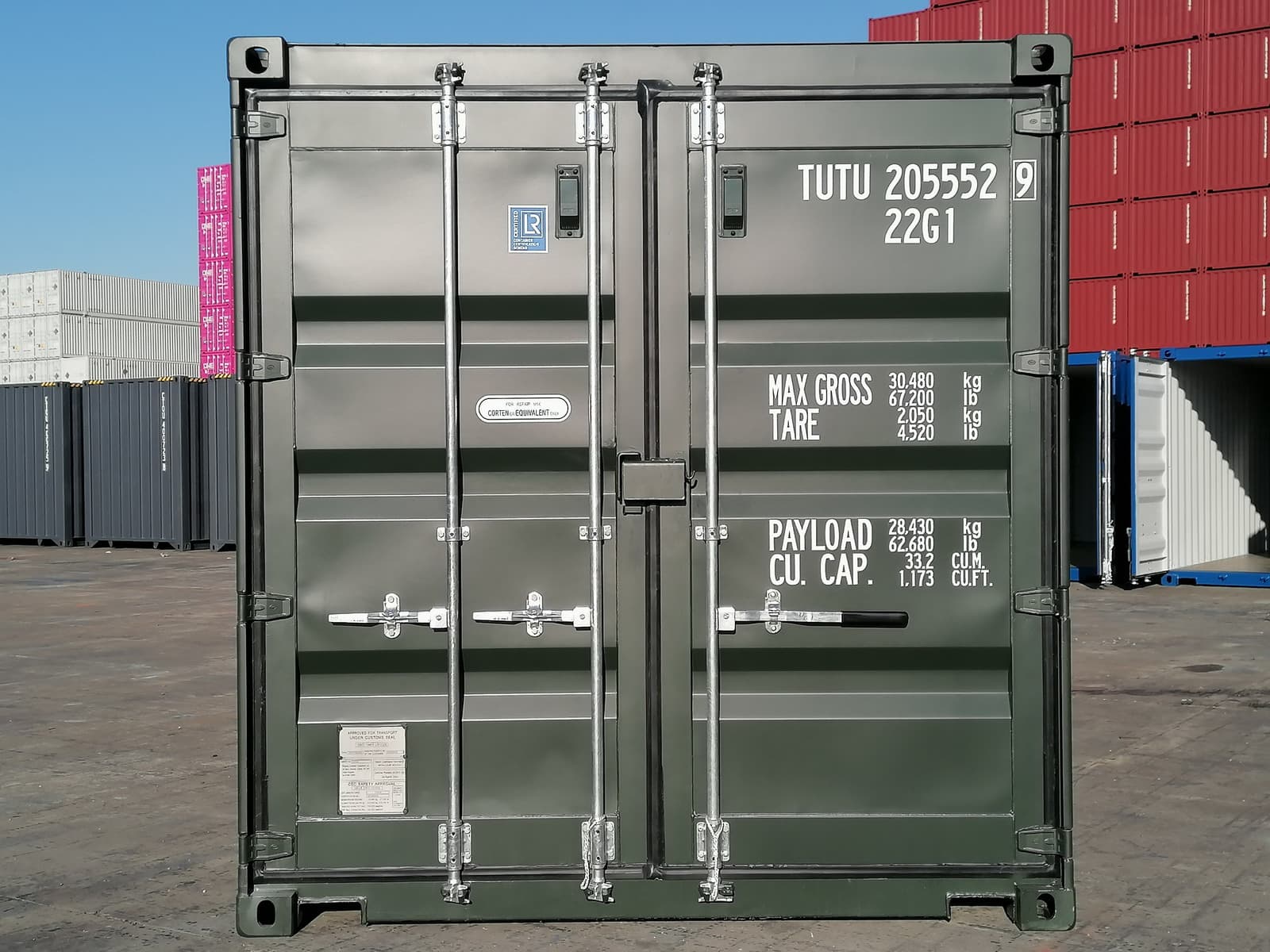
- Humans react to visual signalling rather than legal reality: a rusting, dented ex-shipping line container painted in garish faded red screams 'fly-tipping and permanent blight' to parish councillors; a spotless RAL 6007 bottle green unit placed behind a tree line signals 'thoughtful, temporary agricultural infrastructure'.
- Buying cheap, unseen containers from national internet drop-shippers is the number one cause of planning enforcement visits—because uninspected units arrive with corroded panels that provoke immediate neighbour complaints.
1. The Rationalist's Delusion: Why Planning Is 80% Psychology
If an alien economist landed in rural Suffolk and was tasked with solving an arable farmer's machinery storage problem, they would look at the options and be utterly bewildered by human behaviour.
Option A: Commission an architect, submit a 40-page environmental impact statement, spend £14,000 on structural engineers, wait nine months for a local planning committee to debate roof pitch angles, and pay £45,000 to erect a permanent steel-framed portal barn with concrete foundations.
Option B: Ring a depot at Felixstowe Port, order two 20ft Corten steel ISO shipping containers for less than £4,500 delivered, offload them onto railway sleepers behind a hedge in 20 minutes, and gain 2,340 cubic feet of weather-sealed, rodent-proof, fire-resistant, relocatable storage.
Yet many landowners hesitate because of a single, deeply misunderstood dread: 'Will the council force me to take it down?'
The great mistake people make when thinking about British planning law is assuming it is an algorithm. In truth, as any student of behavioural economics knows, planning control is fundamentally a system of human emotional perception, loss aversion, and aesthetic prejudice dressed up in legal jargon.
Nobody has ever phoned a parish council to complain about an object they couldn't see, couldn't hear, and that didn't look like an eyesore. Planning enforcement is almost never initiated by automated satellite surveillance; it is almost entirely triggered by an irritated neighbour looking across a fence and feeling offended by what they perceive to be an act of industrial vandalism.
2. Is a Shipping Container a Building? The Three Legal Tests
Under Section 55 of the Town and Country Planning Act 1990, 'development' is defined as either the carrying out of building, engineering, mining or other operations in, on, over or under land, OR the making of any material change in the use of any buildings or other land.
So, is a 20ft or 40ft container a 'building'? In the landmark Court of Appeal authority Skerritts of Nottingham Ltd v Secretary of State for the Environment (2000), three essential criteria were established to determine whether a structure constitutes a building:
1. Size: Can it be normally transported on the public highway without being dismantled? A 20ft container (2.44m wide, 2.59m high, 6.06m long) arrives on the back of a standard lorry in one piece. It does not require construction on site.
2. Permanence: Is it designed to endure indefinitely in one place, or is it relocatable? Because a container sits upon the ground under its own weight and can be lifted off in 10 minutes by a crane lorry, it possesses the legal characteristics of a movable chattel.
3. Attachment to the ground: Has it been bolted down to foundations, plumbed into main drainage, or physically bonded to the soil? If a container rests on concrete pads or railway sleepers without ground penetration, the case for it being a temporary chattel rather than operational development is vastly strengthened.
However, beware: even if a container is deemed a chattel, keeping it on land for a prolonged period can constitute a 'material change of use' of the land itself. If your field is zoned for agriculture, and the container is used to store animal feed, fencing supplies, or tractor implements, there is no change of use — it is being used for agriculture. But if you fill that container with furniture, run an internet retail business from it, or rent it out to tradesmen, you have materially changed the use of the land.
3. Agricultural Permitted Development Rights (Class A & B GPDO)
If your land is an established, registered agricultural holding, the Town and Country Planning (General Permitted Development) (England) Order 2015 provides robust statutory rights under Part 6 of Schedule 2:
Key caveat: You cannot claim agricultural Permitted Development rights if your holding is a purely hobbyist smallholding without genuine commercial agricultural output. The use must be 'reasonably necessary for the purposes of agriculture within the unit'.
| Holding Category | Statutory Rule | Permitted Container Scope |
|---|---|---|
| Large Holdings (5+ Hectares) | Class A, Part 6 GPDO | Permits structures reasonably necessary for agriculture. Structures up to 1,000 sq m ground area allowed. Requires 28-day Prior Notification to local planning authority (LPA). |
| Small Holdings (0.4 to 5 Hectares) | Class B, Part 6 GPDO | Permits extensions or alterations to existing agricultural buildings. Does not permit new freestanding buildings, but allows temporary structures strictly ancillary to farming operations. |
| Temporary 28-Day Rule | Class B, Part 4 GPDO | Permits the temporary use of land for any purpose for not more than 28 days in total in any calendar year, including the placement of movable containers for seasonal events or harvest overspill. |
| 10-Year Immunity Rule | Section 191 TCPA 1990 | A container that has remained continuously in position for 10 or more years without enforcement action becomes immune from planning enforcement and eligible for a Certificate of Lawfulness. |
4. The Visual Signalling Paradox: Why RAL 6007 Green Defuses Panic
In evolutionary biology, animals use color to signal either harmless camouflage or deadly toxicity. Human bureaucracies operate under precisely the same subconscious mechanism.
Consider what happens when a farmer orders a weathered, ex-shipping line container from a national online broker. It arrives with faded Mediterranean Shipping Company yellow paint, a peeling Maersk logo, patches of rust, and graffiti on the doors. You drop it by your farm gate.
To the local parish councillor driving past on their morning commute, that rusting steel cube triggers an immediate visceral alarm: 'Industrial fly-tipping. Decadence. Rural decay. What next? A car breaker's yard?' Within 48 hours, an email is fired off to the planning enforcement department.
Now consider the exact same 20ft Corten steel box, but sourced from our Felixstowe siding in factory-applied RAL 6007 Bottle Green.
It sits tucked against a hawthorn hedgerow. The smooth, satin-finished dark green absorbs the rural daylight. It matches the leaves, the tractors, and the traditional corrugated roofs of East Anglia. To that same parish councillor, the object is visually invisible. If noticed at all, it signals: 'Neat, tidy, professional farming equipment.'
You haven't changed the planning law by a single syllable. But by changing the visual signalling, you have reduced the probability of an enforcement visit by 95%. That is the power of behavioural design in procurement.
5. The Hidden Cost of Buying Cheap Unseen Containers
Here is the great B2B procurement trap of the container market: the spreadsheet comparison.
A business owner sits at their desk in Norwich or Colchester. They see an online advert from a national website promising a '20ft Used Container for £1,200'. Container Consultants at Felixstowe quotes £1,450 for an inspected WWT unit or £2,150 for a pristine One-Trip.
The spreadsheet-minded manager thinks: 'Aha! I'll save £250 and buy the cheap one online.'
What actually happens? The national internet broker doesn't own a single container. They are a lead broker in an office in Manchester. They purchase a blind, rejected off-hire container from the bottom of a stack in a regional depot. It is loaded onto a subcontractor's lorry without inspection.
When it arrives at the farm, the driver discovers the door hinges are seized solid with salt corrosion, requiring two men with a scaffold pole to open. The floor has been contaminated with industrial chemicals from a previous cargo. The roof has hairline pinholes that leak rainwater over £8,000 worth of grain bags during the first November storm.
And because it looks like a rusting wreck, the neighbours report it to the council within a week.
By trying to save £250 on the purchase price, the buyer has incurred £2,500 in ruined stock, hours of wasted labour, and a planning enforcement notice. This is what Rory Sutherland calls 'irrational penny-pinching': optimizing a visible minor metric while blindly multiplying systemic risk.
6. The 5 Commandments of Siting Containers on Farmland
If you intend to position containers on agricultural or commercial land in Suffolk, Norfolk, Essex, or Cambridgeshire, follow these five golden rules to ensure maximum operational utility with minimum regulatory friction:
1. Never pour permanent concrete foundations under a container unless you have full planning permission. Rest it on pre-cast concrete railway sleepers, paving slabs, or a compacted Type 1 hardcore pad. This preserves its legal status as a movable chattel.
2. Always specify RAL 6007 Bottle Green for rural and agricultural settings. Never deploy brightly colored shipping line liveries (bright blue, yellow, or terracotta) in sensitive open countryside.
3. Position the container within the existing farmstead envelope. Siting it against existing barns, silage clamps, or mature tree belts minimizes visual intrusion and aligns with planning policy on rural grouping.
4. Keep the internal contents strictly agricultural. Storing seed, fertiliser, equipment, fencing, and seasonal grain implements is completely lawful on an active farm. Running a commercial car repair workshop is not.
5. Buy from a verified port depot where you can verify the condition before dispatch. At Shipping Container Consultants, our units carry registered BIC identification and are physically checked for door alignment and watertight seals at Felixstowe.
Planning questions about your specific site? Call Head Office on 01449 744951, Stephen Mills on 07802 776942, or Charles Camp on 07879 841 007. We will examine your site on satellite maps and recommend the exact specification and positioning to keep your operation smooth, secure, and compliant.