Ground Preparation & HIAB Crane Delivery in East Anglia: A Complete Guide
Why 32-tonne lorries, wet Suffolk clay, and over-optimistic gateways don't mix — and how four humble railway sleepers save you from a logistical migraine.
Key Takeaways for East Anglian Site Managers
- A laden 8-wheel rigid HIAB crane lorry weighs up to 32 tonnes — if your track gets soggy in November, physics will always beat optimism.
- Containers are self-supporting steel bridges; you only ever need four level corner supports, provided ground stability and outrigger bearing are verified.
- A 25mm level discrepancy causes 'container racking', transforming an easy-open door into an Olympic-level test of human strength.
- We provide preliminary desktop access checks across Suffolk, Norfolk, and Essex before our haulier departs Felixstowe.
1. The Psychology of Delivery Day
In the behavioural marketing world, Rory Sutherland often points out that human beings are remarkably bad at estimating physical scale until an object is physically sitting in front of them. When you order a 20ft or 40ft shipping container online, it feels like an abstract purchase — a tidy little storage box.
Then delivery day arrives. A 32-tonne, eight-wheeled steel vehicle piloted by an experienced haulier pulls up outside your gate. Suddenly, you realise that 2.2 tonnes of Corten steel is not an ordinary delivery parcel. It does not fit through a gap designed for an Austin Cambridge in 1964.
At Shipping Container Consultants Ltd, our goal is to eliminate delivery-day friction before the wheels turn on the dock sidings at Felixstowe. Delivering a container should be as predictable as possible — provided you respect site geometry, clearance envelopes, and ground mechanics.
Never assume a commercial lorry can make it down your farm track simply because your tractor romps through it. A laden HIAB lorry has tarmac-friendly commercial tyres and high axle weights. If your entrance has soft grass verges, tight turn-ins, or overhead service lines, contact us on Head Office: 01449 744951 or Direct: 07879 841 007. We will review your gate approach on satellite imagery to check obvious routing constraints before we dispatch (please note: satellite checks provide initial route guidance and do not constitute a formal lifting-safety assessment).
2. The Lorry Anatomy: Rigid 8-Wheelers vs Artics
In 95% of agricultural, commercial, and private estate deliveries across Suffolk and Norfolk, we deploy a specialised truck-mounted hydraulic crane lorry — universally referred to in the UK freight industry as a HIAB.
Unlike an articulated skeletal container lorry which simply pulls up and expects an on-site telehandler or heavy gantry crane to hoist the box, our HIAB crane lorries are self-offloading. The vehicle arrives with the container secured to its bed, deploys hydraulic stabiliser outrigger legs onto firm ground with spreader pads, lifts the unit smoothly into the air, and places it safely onto the ground adjacent to the vehicle within the crane's certified safe working radius, subject to site terrain, obstacle clearances, and ground bearing stability.
Because our haulage partners dispatch directly from the sidings of Felixstowe Port along the A14 and A12 trunk routes, drivers are exceptionally familiar with the practical challenges of East Anglian deliveries — from tight turns in historic Suffolk market towns to unmade farm tracks across Norfolk and Essex.
3. Gateway Geometry: Preliminary Screening Baselines (3.2m–3.5m)
Before confirming your delivery date, it is vital to audit the exact access corridor from the public highway to the drop-off footprint. The dimensions below represent preliminary screening baselines only, not guaranteed clearances or proof that an individual delivery is possible. Actual vehicle access, crane reach, lifting capacity, and ground bearing are separate technical checks and must be evaluated for your specific site geometry.
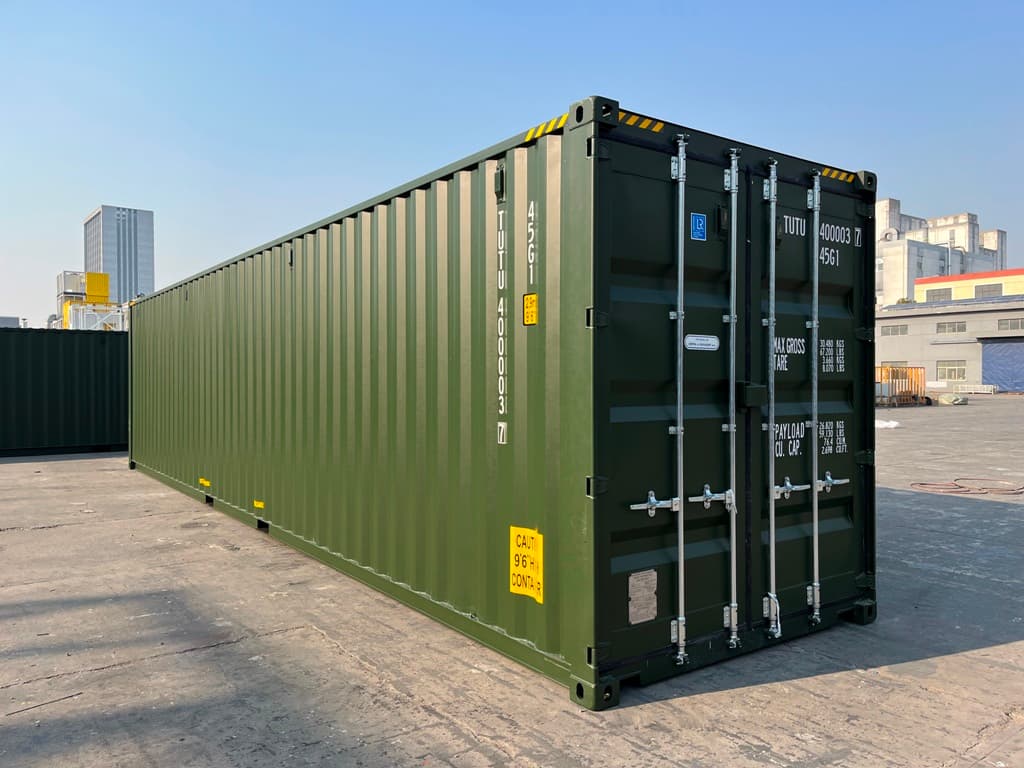
The most common delivery vehicle for a single 20ft container is a 32-tonne, 8-wheel rigid HIAB vehicle measuring approximately 10 metres (33ft) in length and 2.55 metres (8ft 4in) in width (excluding extended mirrors). For a 40ft container, an articulated tractor and trailer combination measuring up to 16.5 metres (54ft) is standard.
Overhead Electricity Lines & Cable Safety
In rural Suffolk and Norfolk, overhead power lines and utility cables present serious electrical hazards during crane and transport movements. Under HSE Guidance Note GS6 (Avoiding danger from overhead power lines), work near overhead lines must be thoroughly planned and controlled to prevent danger. The line voltage cannot be assumed from the support structure alone, as wooden poles can carry high-voltage lines of up to 132,000 volts (132 kV).
Under HSE principles, the preferred approach is always to eliminate the danger—for instance by selecting an alternative drop footprint away from lines, or arranging line de-energisation (isolation) or diversion with the line owner or Distribution Network Operator (DNO, such as UK Power Networks). The relevant network operator must establish the applicable safe clearances and operational requirements. Where work or vehicle passage near or beneath lines is proposed, operations must not proceed unless a competent site-specific assessment establishes and implements adequate controls (such as ground barriers, goalposts, or exclusion zones). Consulting a network operator or conducting a preliminary desktop route review does not on its own make the operation safe or constitute an approved lifting plan.
Crane Outrigger Leg Loads vs Axle Weights
When the lorry prepares to hoist the container, the driver must extend heavy hydraulic outrigger legs to anchor the chassis. These outriggers exert high concentrated point loads onto the ground, differing fundamentally from rolling vehicle axle weights. The setup requires firm, level ground and dedicated crane outrigger spreader pads. Ground stability must be assessed independently on site; if your driveway is bordered by deep drainage ditches, soft verges, septic tanks, or unreinforced culverts, notify our operations desk prior to booking so that vehicle placement and ground support can be evaluated.
| Vehicle Type | Target Container | Preliminary Straight Gate Screening Width | Preliminary Overhead Clearance | Turning / Clearance Notes |
|---|---|---|---|---|
| 8-Wheel Rigid HIAB | 20ft Standard | Indicative 3.2m straight approach (screening only) | 4.5m (14ft 9in) transit | 11.5m circle; wider gateway required on turns |
| Articulated Crane Lorry | 40ft Std / High Cube | Indicative 3.5m straight approach (screening only) | 4.5m (14ft 9in) transit | 18.0m corridor; substantial swing clearance |
| Customer Skeletal Lorry | 20ft / 40ft (No crane) | Indicative 3.2m straight approach (screening only) | 4.5m (14ft 9in) transit | Standard highway turning; site offload facility required |
4. East Anglian Geology (Suffolk Clay vs Fenland Peat)
The geology of East Anglia presents distinct challenges for heavy storage structures. The heavy clay soils of Mid-Suffolk expand when wet and contract during dry summers, while the fenlands of North Cambridgeshire and West Norfolk feature peat and alluvial silts that compress readily under point loading.
A 20ft container has an unladen tare weight of roughly 2,200 kg. Once loaded with farm machinery, workshop tools, or retail surplus stock, the gross weight often reaches 6 to 10 tonnes. If placed directly onto damp grass or raw soil, two problems arise immediately: moisture wicks upwards into the marine plywood flooring, and uneven ground subsidence causes the container frame to twist out of square.
5. The Four-Corner Method: Sleepers vs Concrete Flags
Many first-time container buyers mistakenly believe they must pour an expensive, solid concrete raft foundation across the entire 20ft x 8ft or 40ft x 8ft footprint. This is almost never necessary for standard yard storage.
ISO containers are engineering marvels designed to be self-supporting entirely through their four corner posts and heavy cast-steel corner castings. The corrugated Corten side walls act as structural load-bearing girders. Therefore, you only need to provide solid, level foundation points directly beneath the four corner castings.
Option A: Heavy Hardwood Railway Sleepers (Most Popular)
Treated timber railway sleepers (typically 2.6m x 250mm x 150mm) provide an exceptional, cost-effective base for agricultural and equestrian sites in East Anglia. Position two sleepers across the width of the container footprint — one directly under the front pair of corner castings and one under the rear pair. Timber provides natural micro-flexibility while keeping the container raised 150mm off the damp soil, ensuring continuous airflow beneath the steel chassis.
Option B: Pre-Cast Concrete Paving Slabs or Steel Plates
For hardstanding yards, compacted MOT Type 1 stone, or tarmac compounds, four 600mm x 600mm council-grade concrete paving flags or 10mm steel spreader plates placed under each corner will evenly distribute point loads and prevent sinking.
6. The Agony of the Racked Door
If there is one single piece of advice that saves container owners hours of frustration, it is this: make sure your corner pads are dead level with each other using a spirit level or laser level prior to delivery.
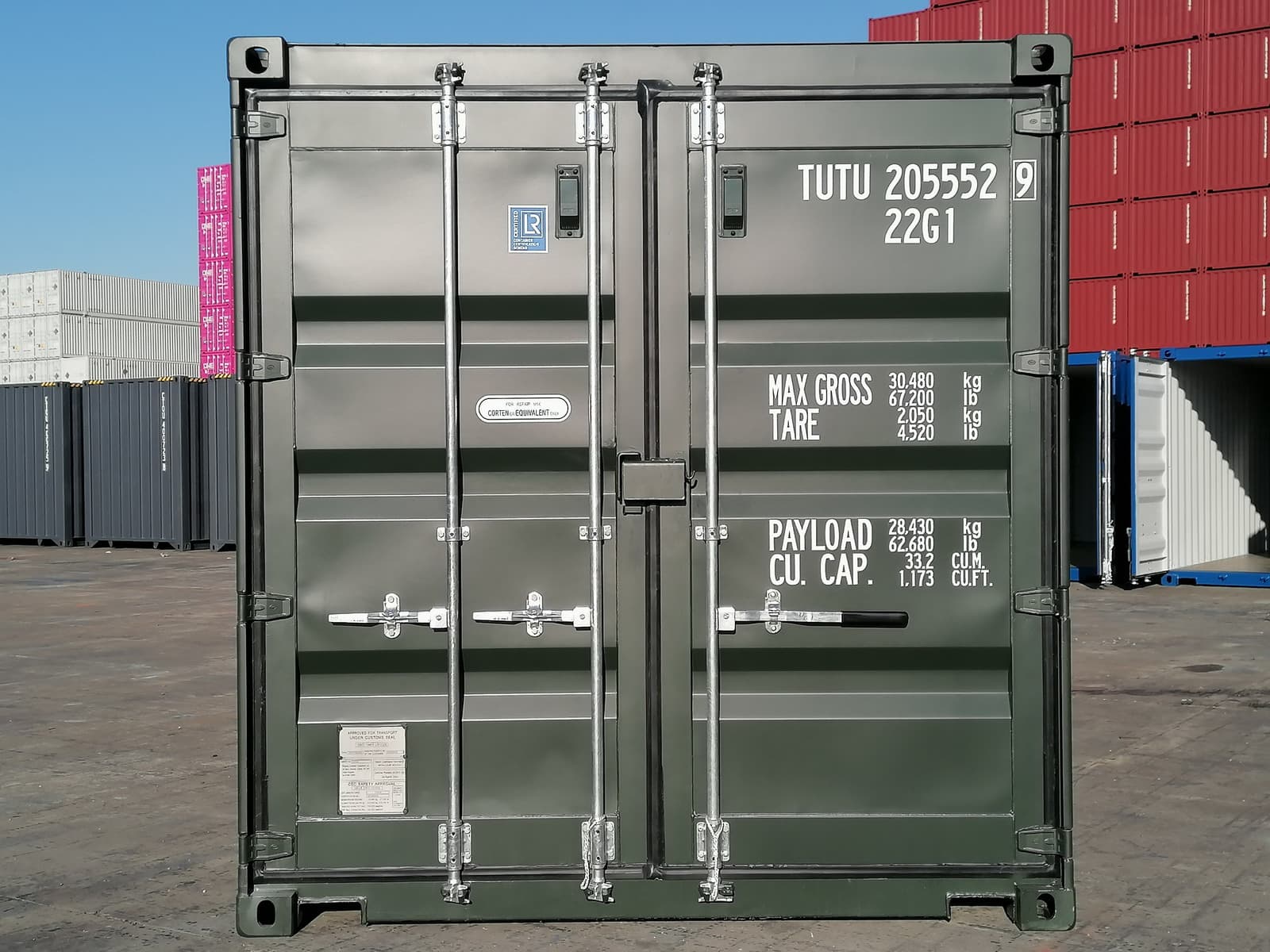
Shipping container double doors rely on tight, heavy-duty EPDM rubber gaskets to maintain wind and watertight closure. If one of the four corners settles even 25mm (1 inch) lower than the other three, the rectangular end frame 'racks' (distorts into a slight parallelogram). When this happens, the locking bars will bind, making the heavy doors extremely stiff or impossible to latch with one hand.
If your driver arrives and sets the unit down on out-of-level ground, don't worry. Our drivers carry heavy steel shims and timber packing chocks to level each corner casting before unhooking the lifting chains.
7. Pre-Flight Delivery Checklist
Run through this quick 7-point checklist at least 48 hours before our lorry rolls out of Felixstowe:
- Check gateway width: Preliminary screening baselines are 3.2m (10ft 6in) for rigid lorries and 3.5m (11ft 6in) for articulated vehicles on direct, straight approaches only. These are screening figures, not guarantees; wider access is essential when turning from narrow rural lanes, and site access must be assessed.
- Trim low branches: Ensure a clear overhead tunnel of 4.5m (14ft 9in) along the entire delivery transit route.
- Check overhead services: Inspect for overhead electricity cables and ensure compliance with HSE Guidance Note GS6 (avoid danger, establish safe clearances with the network operator, and implement competent site-specific controls; contacting a DNO alone does not make the operation safe or constitute an approved lift plan).
- Verify underground services: Confirm no fragile septic tanks, water mains, or unreinforced culverts lie on the lorry's path.
- Prepare 4 corner pads: Place level timber railway sleepers or 600x600mm concrete flags on the four designated corners.
- Confirm door orientation: Decide whether you want the cargo doors facing into the yard or towards the perimeter fence before the lorry arrives.
- Keep contact phone active: Our logistics desk or lead haulier will ring you ahead of arrival to confirm immediate gate access.